CONNECTIONS
by Mike Slater & Lee Lewis
IMAGES CONTACT
An art-exhibition of people travelling by train
Travelling down the line
The train journey
Changing trains
CONNECTIONS
departs on
20.01.00
and will appear at:
Newtown Station ticket office
Departure lounge at York Station
National Railway Museum, York
New York United States
Photographs, paintings, suspended work, video and sound will link together
to create a sensation of travelling by train
IMAGES CONTACT OTHER EXHIBITIONS
MIKE SLATER HOME & LEE LEWIS HOME
Statement
Connections is an exhibition on travelling by train. It is based on a journey which has a starting-point and may reach an end. People are captured in the process of moving.
A moment in time
is forever caught either on the camera film or on the painter's canvas. All of these moments have been observed in the last twelve months since the meeting of the artists.
Mike Slater and Lee Lewis, the artists of the Connections exhibition, met at Newtown train station in mid Wales. Lee was changing her York train ticket to allow a better chance of seeing the 1999 eclipse. Mike's office and art gallery are at Newtown train station and they got talking. The idea was created of a shared project involving Mike's photography and Lee's paintings. Later, the nature of the meeting place at a train station gave rise to the theme of an exhibition based on train travel. The process of
watching people in their own personal journeys
on the train was mirrored in the development of the artists' own journey together.
The images. Twenty black-and-white photographs and twenty oil paintings will be instantly recognisable to anyone who travels by train in Britain today. Every image has been captured since Autumn 1999. The new colours of the new train companies. The modern train station. The styles of clothes people were wearing at the transition from the Twentieth to the Twenty-first Century are all obvious in the work.
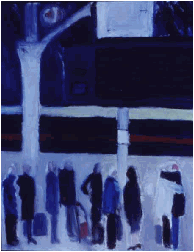
Yet, Mike's black-and-white photographs are timeless in their imagery. The figure standing under the huge clock at York's Platform 3 could be from an earlier era as well as being relevant to York station today. Lee's bold paintings of people on the platform at first glance give no clue as to the country of origin or time-frame but the livery of the newly privatised train companies fix the travellers forever at the start of the new Millennium.
Publicity surrounding the railways can often be negative and yet Mike and Lee discovered that most people were enjoying their experience. Children stand excited on the platform waiting for the imminent arrival of the train. A journey is passed half-asleep listening to Radiohead on a personal stereo.
Time is important.
The York station clock, Platform 3, ticks away the hours and a woman late for a London train runs down the platform. The railway industry continues counting away the hours and running trains to their destinations. People stand below the departure board. A timeless succession of events within a modern industry.
The video. A 45-minute video is a snatch-shot of the reality of travel in 2000 at a small station in Wales. The video explores the life at a station prior to the arrival of the most popular Saturday morning train to Shrewsbury. Shoppers, families on a day-out and people travelling to work gather at Platform 2 of Newtown station to board the 10.11 morning down-train. The arrival of the train is met by a scramble to gather belongings, the guard checks that people board safely and then the train is gone and the platform is silent for a while.
An event which happens every day,
every year but captured now in 2000 to remind us of how we were then (and now).
How we were then. The Connections images are passing by. The onward journey continues and new images emerge. New styles, new corporate colours, new people. We rarely pause to consider our own procession through life. By capturing everyday events such as train travel, the artist can create a resonance with the future which reminds people of
how they were now,
back in 2000. In a world of mass media intrusion, many of our normal activities are rarely captured in detail. Life on trains may if we are not careful be undocumented and unknown to future generations. What is life really like at York station in 2000? Our past is important to us all and Connections gives insight and documentation in to how we are now.
It is good to stop sometimes, look around and record what you see. That is the aim of the Connections exhibition and in bringing it to the National Railway Museum, the artists hope to give many people the opportunity to see the reality of modern train travel and to also stop to think about the stage that the viewer has reached in their own personal journey through life.